

Germany Hydrogen Economy Market is expected to reach US$ 20.77 billion by 2032 | DataM Intelligence
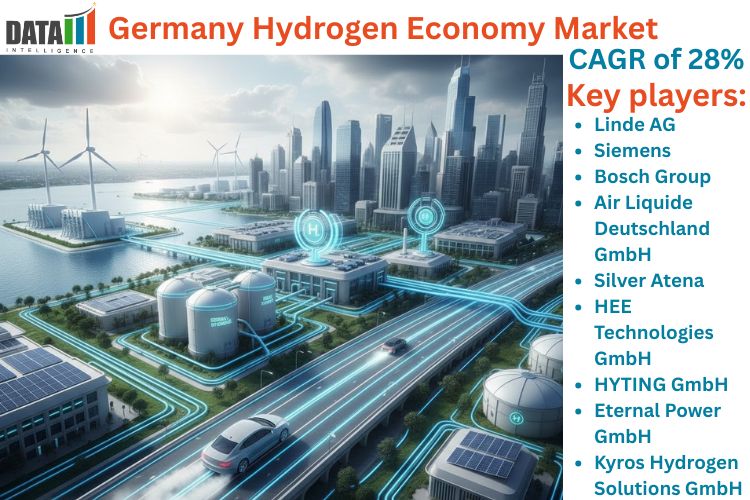
Germany Hydrogen Economy Market
The Germany Hydrogen Economy Market is expected to reach at a CAGR of 28% during the forecast period 2025-2032.
The Germany Hydrogen Economy Market is expanding with strong government backing, rising green hydrogen projects, and industrial decarbonization demand boosting future growth.”
AUSTIN, TX, UNITED STATES, December 19, 2025 /EINPresswire.com/ -- Overview of the Market:— DataM Intelligence
The Germany Hydrogen Economy Market is emerging as one of Europe’s most dynamic clean-energy industries, driven by the nation’s ambitious decarbonization programs and strong industrial policy support. Germany aims to accelerate carbon neutrality, replace fossil-fuel systems, and develop a sustainable hydrogen value chain that stretches across production, storage, distribution, and end-use consumption. The market benefits from Germany’s favorable regulatory structure, government funding, innovative technology adoption, and powerful industrial clusters positioned to lead the global green transition. According to DataM Intelligence, The Germany Hydrogen Economy Market was valued at around US$ 10.05 billion in 2024 and is projected to reach US$ 20.77 billion by 2032, registering a CAGR of 28% between 2025 and 2032. Major sectors adopting hydrogen include fuel-cell mobility, industrial operations, power generation, and chemical manufacturing, driving large-scale demand growth across the forecast period.
To Download Sample Report Here: https://www.datamintelligence.com/download-sample/germany-hydrogen-economy-market
The main factor fueling the sector is Germany’s long-term climate roadmap, which targets energy diversification, net-zero emission infrastructures, and reduction of gas import dependency. The leading segment within the market is green hydrogen production, supported by rapid advancements in electrolysis technology and renewable power capacity expansion. Geographically, Northern Germany currently dominates the market due to its coastal infrastructure, offshore wind resources, and industrial hydrogen fuel hubs that support large-scale pilot projects and research collaborations.
Key Highlights from the Report:
Market expected to witness a strong CAGR due to increasing national hydrogen funding and technology innovation.
Green hydrogen segment remains the fastest-growing category, backed by large renewable energy capacity additions.
Mobility and transportation hydrogen usage expanding through fuel-cell buses, trucks, and maritime applications.
Northern Germany leads regional development due to offshore wind potential and government pilot clusters.
Significant partnerships emerging between energy utilities, electrolysis manufacturers, and automotive companies.
Hydrogen-powered electricity storage is gaining traction as part of renewable balancing solutions.
Market Segmentation:
The Germany Hydrogen Economy Market is segmented based on hydrogen type, production technology, and end-user industry. The hydrogen type category includes green, blue, and grey hydrogen. Green hydrogen is expected to dominate the outlook because it aligns directly with Germany’s renewable energy goals. Blue hydrogen may remain a secondary option, particularly during transition phases, as industries reduce dependence on carbon-heavy fuels. Grey hydrogen, historically produced using natural gas, continues to decline due to policy restrictions and carbon-reduction goals.
From a production technology standpoint, proton exchange membrane (PEM) electrolysers and alkaline electrolysers represent the most applied technologies. PEM systems are preferred in automotive and industrial fuel-cell applications, offering rapid startup abilities and high-density output. Alkaline electrolysers are increasingly used in utility power generation environments where low-cost operation and large-scale deployment are priorities. Solid oxide electrolysers are gaining research momentum because of high efficiency and integration compatibility with industrial waste heat.
In terms of end-user segmentation, transportation, chemicals, industrial manufacturing, and power generation are key demand categories. Heavy industries such as steel, cement, and refining are emerging as large hydrogen consumers as companies invest in emissions reduction programs. Fuel-cell vehicles and hydrogen transport corridors across major German cities are rapidly evolving as commercial fleets and logistics operators begin reducing diesel usage. Additionally, hydrogen-based electricity storage provides a long-term solution to intermittent solar and wind supply challenges.
Speak to Our Analyst and Get Customization in the report as per your requirements: https://www.datamintelligence.com/customize/germany-hydrogen-economy-market
Regional Insights:
Germany’s hydrogen industry is geographically diverse, with strong strengths in different regions. Northern Germany stands out due to its coastal energy infrastructure and offshore wind capacity, allowing large-scale renewable integration for green hydrogen development. This region hosts multiple hydrogen innovation clusters and research facilities dedicated to fuel-cell systems, storage networks, and renewable-power-based hydrogen conversion.
Southern Germany displays high adoption in the automotive and machinery manufacturing sectors, making it a strong cluster for hydrogen vehicle development and industrial fuel-cell integration. Central Germany is steadily expanding hydrogen-based transportation links and refueling networks, helping to support regional mobility expansion across logistics, road transport, and public bus fleets. Eastern Germany hosts several hydrogen-powered electricity production facilities and is becoming a hub for green hydrogen research through academic partnerships and public-private funding.
Market Dynamics:
Market Drivers
Decarbonization is the strongest driver in the Germany Hydrogen Economy Market. National climate programs and regulatory incentives encourage utilities and industries to shift from fossil fuels to hydrogen-based energy systems. Rapid growth in renewable energy sources, including solar and wind, supports hydrogen manufacturing using excess generation capacity, improving grid reliability and operational flexibility. Automotive manufacturers are accelerating fuel-cell vehicle innovation amid strict EU emissions standards, increasing hydrogen adoption. Furthermore, energy security is emerging as a priority, pushing Germany to reduce reliance on imported fossil fuels and expand domestic hydrogen supply capabilities.
Market Restraints
The market faces multiple challenges, including high hydrogen production costs, limited storage infrastructure, and transportation complexity. Electrolysis technology requires heavy investment, making green hydrogen comparatively expensive against conventional fuels. Large-scale hydrogen transportation demands extensive pipeline and supply network development, which is time-consuming and expensive. Additionally, regulatory barriers and certification requirements slow project timelines, while consumer-side awareness about hydrogen remains low.
Market Opportunities
Opportunities are expanding across mobility, industrial manufacturing, and carbon-free energy storage solutions. Investments in hydrogen refueling stations, heavy-duty vehicles, and marine fuel projects are expected to multiply. Technology innovations are reducing electrolysis costs and enhancing operational efficiency, making hydrogen more competitive. Government grants, joint ventures, and sustainable industry partnerships will pave the way for supply chain expansion. Furthermore, the export potential for green hydrogen to neighboring European markets opens new revenue streams for Germany’s energy sector.
Buy Now & Unlock 360° Market Intelligence: https://www.datamintelligence.com/buy-now-page?report=germany-hydrogen-economy-market
Frequently Asked Questions (FAQs):
How big is the Germany Hydrogen Economy Market?
What is the growth outlook and projected CAGR for the Germany Hydrogen Economy Market?
Who are the leading hydrogen technology players operating in Germany?
What is the market forecast and future expectation for 2032?
Which German region is expected to dominate hydrogen production and development?
Company Insights:
Key players operating in the Germany Hydrogen Economy Market include:
Linde AG
Siemens
Bosch Group
Air Liquide Deutschland GmbH
Silver Atena
HEE Technologies GmbH
HYTING GmbH
Eternal Power GmbH
Kyros Hydrogen Solutions GmbH
Sauerstoffwerk Friedrichshafen GmbH
Recent Developments:
Germany:
December 2025: The Louisiana Clean Hydrogen Task Force wait, no, in Germany context: Stakeholders reported lagging market development via the H2 Market Index (41/100 score), urging reduced bureaucracy amid project cancellations; separately, Panasonic began a hydrogen demonstration at its Munich campus in March but ongoing in late 2025.
November 2025: Germany announced €6 billion ($7 billion) in 2026 funding for hydrogen and carbon capture projects, alongside a more flexible auction format to support infrastructure ramp-up.
October 2025: The Federal Cabinet adopted the Hydrogen Acceleration Act on October 1, streamlining approvals for the entire hydrogen supply chain including electrolyzers, storage, pipelines, and synthetic fuel facilities.
United States:
November 2025: Exxon Mobil paused its major blue hydrogen production facility plans due to weak customer demand, despite $500 million already invested with partners like ADNOC.
October 2025: The U.S. Department of Energy terminated 223 clean energy projects, including some hydrogen-related initiatives, to save over $75 billion amid policy shifts under President Trump.
September 2025: ECL announced construction of a 1 GW hydrogen fuel cell-powered data center near Houston, with the first 50 MW phase slated for summer 2025 operation at a $450 million cost, aiming for full 1 GW capacity using on-site hydrogen from gas pipelines.
Japan:
November 2025: Japan introduced a new 15-year Contract for Difference (CfD) scheme to guarantee price stability and accelerate low-carbon hydrogen deployment across supply chains.
October 2025: The Hydrogen Society Promotion Act took effect, enabling a Yen 3 trillion ($19 billion) price gap subsidy framework; applications for low-carbon hydrogen supply projects ran from late November to March 2025.
September 2025: Toyota joined the TOKYO H2 project launched by the Tokyo Metropolitan Government, adding Crown fuel cell vehicles to the taxi fleet to position Tokyo as a global hydrogen leader.
Unlock 360° Market Intelligence with DataM Subscription Services: https://www.datamintelligence.com/reports-subscription
Conclusion:
Germany stands at the forefront of Europe’s hydrogen economy transition, supported by strong political commitment, advanced engineering capabilities, and rapidly evolving energy systems. The market will continue to expand as hydrogen becomes a crucial pillar of industrial decarbonization, transportation modernization, and renewable energy storage. While challenges remain in cost, infrastructure, and mass deployment, increasing collaboration between government, research institutions, and private enterprises will establish sustainable hydrogen ecosystems across the nation. With long-term demand from manufacturing, mobility, and power generation industries, Germany is positioned to emerge as a global leader in green hydrogen technology and production, shaping the future of carbon-neutral energy markets.
Related Reports:
Hydrogen Energy Storage Market
Hydrogen Storage Market
Sai Kiran
DataM Intelligence 4Market Research
+1 877-441-4866
Sai.k@datamintelligence.com
Visit us on social media:
LinkedIn
X
Legal Disclaimer:
EIN Presswire provides this news content "as is" without warranty of any kind. We do not accept any responsibility or liability for the accuracy, content, images, videos, licenses, completeness, legality, or reliability of the information contained in this article. If you have any complaints or copyright issues related to this article, kindly contact the author above.
